
Company Providing Hood Cleaning in Denver, Colorado Stresses Safety for 2009
Friday, January 22, 2009 — DENVER, COLORADO — It’s a new year, and American Professional Services (APS-Hoods) a company that provides hood cleaning in Denver, Colorado, seeks to bring attention to safety in 2009.
Keeping property and employees safe in the commercial restaurant kitchen requires routine cleanings of kitchen hood, duct and fan systems at a minimum, said Massoud Farazandeh, general manager of Nationwide Fire Protection Corp., an affiliate of APS-Hoods.
The U.S. Fire Administration and National Fire Data Center released a study in 2004 on restaurant fires that had occurred in 2002- the most current year for which information is available, according to the USFA.
The study found that as a result of the approximately 7,100 restaurant structure fires that occurred that year, those fires caused $116 million in property damage.
“What is encouraging is the role that fire protection equipment played in those statistics,” Farazandeh said.
Less than one-third of the reported structure fires “occurred in an area that was known to have a fire alarm, and less than half of fires occurred in an area with an automatic extinguishment system, such as automatic sprinklers,” the report stated. (http://www.usfa.dhs.gov/downloads/pdf/tfrs/v4i3.pdf )
About 64 percent of the restaurant structure fires were caused by cooking. Cooking materials such as grease and oil were the most frequent items first ignited.
“These statistics drive home the point that a properly inspected, maintained and functioning fire protection system, along with routine hood cleaning, can go a long way to preventing costly damage, loss of property and potentially loss of life from restaurant fires,” Farazandeh said.
Following are some guidelines restaurants can follow to help prevent disastrous fires.
Routine Cleaning
The International Kitchen Exhaust Hood Cleaning Association, a Maryland-based trade association dedicated to educating its members about safety and cleaning techniques, has a list of standard guidelines and practices for contractors engaged in kitchen exhaust cleaning, according to its Web site (http://www.ikeca.org/default.htm ).
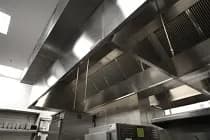
Restaurant kitchen ducts, hoods and fans should be cleaned by qualified professionals, such as the Denver, Colorado suppression systems and cleaning experts at APS-Hoods, Farazandeh said.
Proper cleaning of this equipment is comprehensive and requires the use of high-powered equipment and special chemicals, he said. The frequency in which the cleanings should occur depends upon the type of food being cooked in the restaurants, the cooking methods and the type of equipment used. At a minimum, restaurant kitchen systems should be cleaned twice a year. Restaurants that use deep fat fryers and/or charbroilers should clean these systems every three months at a minimum.
Eating establishments that use smokehouses or wood fires should undergo monthly cleanings at a minimum.
Restaurants that use large amounts of vegetable oils in their cooking processes should go no longer than three months between cleanings. When vegetable oil grease is left to build up, it becomes “glue-like” and removing it is a difficult task, Farazandeh said.
Preventative Maintenance
Scheduling regular maintenance service for electrical equipment is paramount to keeping systems in safe operating condition, Farazandeh said.
An electrician or qualified fire suppression systems and fire protection systems specialist should inspect for the following potentially dangerous hazards:
* Sparking or smoking equipment
* Wiring or cords that are frayed
* Too many electrical cords in a socket
* Switch plates and receptacle plates that are broken or cracked
* Ungrounded outlets or plugs
* Insufficient circuit breakers or fuses
* Temporary wiring
* Missing shields on high-intensity lights- especially if the lights are near flammable items
* Grease build-up or dust accumulation on equipment, sockets or wiring
* Combustible items near power sources
Train Staff in Fire Prevention Techniques
A staff that is properly trained in appropriate fire-prevention methods can go a long way to reducing the likelihood of fire occurring.
Staff should be taught to do the following to prevent possible hazards:
* Store flammable liquids in their original containers or in tightly sealed containers that are puncture resistant.
* Store flammable liquids in well-ventilated areas that are separate from supplies, food, food-preparation areas or sources of flames.
* Employees should not smoke in or around storage areas.
* Follow directions when using chemicals, and never combine chemicals together unless the directions call for mixing
* Do not use chemicals in poorly ventilated areas
* Immediately clean up chemical spills
* Keep paper products, linens, boxes and food in dry storage areas and not near heat sources
* Do not pile soiled rags, paper products and trash in storage and working areas; dispose of them at least once a day
Farazandeh said it is a good idea to teach new employees about your restaurant’s evacuation routes and fire safety equipment usage, and to provide periodic refresher courses to veteran staff members. At least one worker per shift also should know how to shut off gas and electrical power if necessary in the event of an emergency.
Learn More
If you would like more information on the hood cleaning services that APS-Hoods offers, call (303) 639-9399, or visit the company’s Web site: www.aps-hoods.com.
About APS-Hoods
APS-Hoods is a full-service restaurant fire protection business that installs, services, repairs and performs routine inspections and cleaning for hood and fire suppression systems. Founded by Chief Executive Officer Massoud Farazandeh in 1989, APS-Hoods has grown into a national leader in hood cleaning and fire protection for restaurants and facilities.
APS provides superior service, a quality guarantee and maintains a highly qualified and dependable staff. All crew members are professionally trained to comply with the National Fire Prevention Association Standards and state and local codes.
APS-Hoods is fully insured and bonded. They are licensed in the mechanical and electrical fields, as well as fire protection contracting. APH-Hoods is affiliated with the National Fire Protection Agency and the Colorado Division of Fire Safety Fire Suppression Program.
-end-
© 2009 Sinai Internet SEO Marketing and APS-Hoods. Authorization to post is granted, with the stipulation that Sinai Marketing is credited as sole source. Linking to other sites from this article is strictly prohibited, with the exception of herein imbedded links.